
The 3-Exercise Minimum: What Your Bones Need Weekly
And Nothing More

You already know resistance training builds bone density. You’ve read the research, you understand the principle, you’re convinced it matters. But you still aren’t doing it consistently, are you?
The problem isn’t motivation. It’s not a lack of knowledge. It’s that most bone health programs are overwhelming (Even the plans I have posted on here have multiple exercises), it can often lead to inaction.
Here’s what the research shows, you don’t need complexity. You need three movements, done consistently, with progressive load. Everything beyond this threshold delivers marginal improvements.
We know that adherence predicts outcomes better than program design. An average program performed consistently for twelve months outperforms a perfect program abandoned after six weeks.
Let me give you the minimum effective intervention. Three exercises that load your entire skeleton. Two sessions weekly and twelve months of consistency.
If you’re enjoying Strong To The Bone - Then please help me grow the newsletter by either subscribing or sharing with a friend. Every addition makes such a difference! I appreciate you all.
Why Simplicity Beats Sophistication
The bone adaptation doesn’t care about your exercise variety. It cares about mechanical load applied progressively over time. If your complex program leads to intermittent training, you’re accumulating weeks and months of missed loading stimulus. Meanwhile, the person doing three exercises religiously is providing their skeleton with consistent signals to adapt.
Dr. Belinda Beck’s LIFTMOR trial, published in the Journal of Bone and Mineral Research in 2018, demonstrated that post-menopausal women with osteopenia performing just three exercises, deadlift, back squat, and overhead press, twice weekly for eight months increased lumbar spine bone mineral density by 2.9% and improved femoral neck density by 0.3%. The control group lost bone density at both sites.
Three exercises. Twice weekly. Measurable bone building.
The greatest skeletal benefits come from targeting large muscle groups crossing the hip and spine with high loads. Everything beyond this principle is optimisation for the sake of optimisation.
The Framework - Loading Your Entire Skeleton With Three Movements
Different bones experience different loading patterns during different movements. To build bone density, you need to load your skeleton through multiple planes of movement and forces. Three movement categories achieve this:
Movement 1: Hip-Dominant (Posterior Chain Loading)
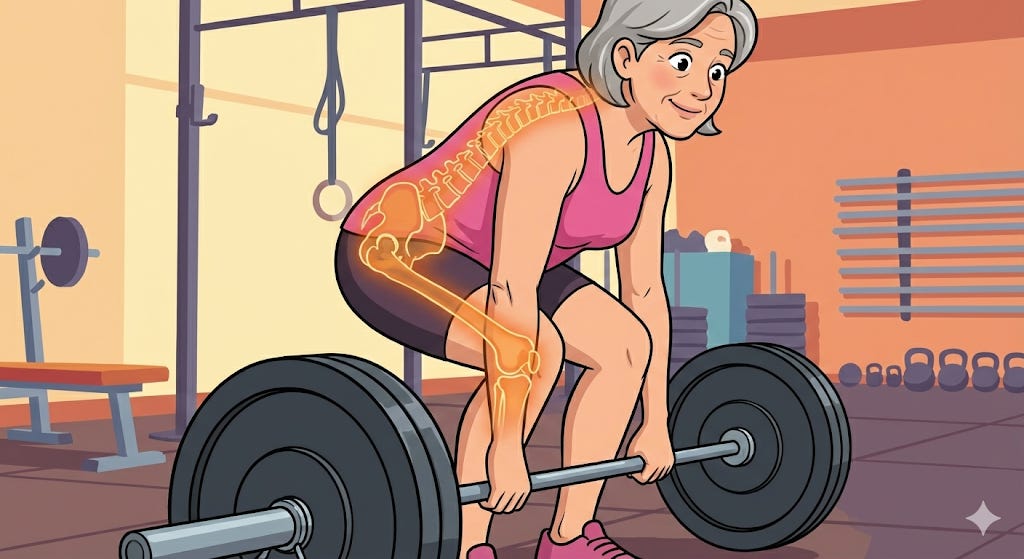
A hip-dominant movement emphasises hip extension driven by your glutes and hamstrings. This category includes deadlift variations, conventional, Romanian, sumo, or trap bar deadlifts. The defining characteristic is a hip hinge pattern where your hips move significantly whilst your knees remain relatively static.
Hip-dominant movements create compressive forces through your lumbar spine, pelvis, and femur. When you deadlift, you’re loading your entire posterior chain, from your calves through your back muscles, with forces that can reach 3-4 times body weight. Research in Bone demonstrates that spinal loading during deadlifts creates microstrain magnitudes exceeding the 1,500 microstrain threshold needed to trigger osteoblast activity. Your vertebrae respond by increasing density at the exact sites most vulnerable to osteoporotic compression fractures.
The deadlift also creates tensile forces where your hamstrings and glutes attach to your pelvis and femur. These pulling forces stimulate bone formation at the attachment sites.
Movement 2: Knee-Dominant (Anterior Chain Loading)
A knee-dominant movement emphasises knee extension driven by your quadriceps. This category includes squat variations, back squats, front squats, goblet squats, or Bulgarian split squats. The defining characteristic is significant knee flexion and extension whilst your torso remains relatively still.
Knee-dominant movements load your femur, tibia, and spine differently than hip-dominant movements. During a squat, your femur experiences compressive forces through its entire length whilst your quadriceps create tensile forces at their attachment points on your tibia and pelvis. Research published in the Journal of Strength and Conditioning Research shows that squats create ground reaction forces of 2.5-3.5 times body weight.
Squats also load your spine (when the weight sits on your shoulders), and compressive forces travel directly through your vertebrae. This vertical loading pattern is distinct from the shear and bending forces dominant in deadlifts. By including both movement patterns, you’re exposing your spine to varied mechanical stresses that promote adaptation.
Movement 3: Vertical Press (Upper Body and Spinal Loading)
A vertical press involves pushing a weight overhead. This includes strict overhead presses, and landmine presses. The defining characteristic is moving a load from shoulder height to overhead whilst your spine supports the weight.
Upper body fractures, particularly wrist, forearm, and shoulder fractures, reduce independence in older adults. Overhead pressing builds bone density throughout your upper body whilst simultaneously loading your spine in extension.
When you press overhead, your humerus, radius, and ulna (arm bones) all experience compressive forces. Your shoulder girdle, scapula (shoulder blade) and clavicle (collar bone) transmits forces from your arms to your torso. Your spine must resist the tendency to hyperextend backwards, creating isometric (static) loading through your entire vertebral column. Research examining upper body resistance training in post-menopausal women found that overhead pressing movements increased forearm bone mineral density by 1.2-1.8% over twelve months, a meaningful adaptation.
Overhead pressing also loads your thoracic spine in extension, which directly counters the forward-flexed posture (kyphosis) that both causes and results from vertebral compression fractures. You’re simultaneously building bone density whilst training the muscular patterns that prevent the postural decline or dowager’s hump.
Why Two Sessions Weekly Is Optimal
The LIFTMOR trial used twice-weekly training and produced remarkable results. This wasn’t arbitrary. Bone tissue requires 48-72 hours to respond to mechanical loading before it’s ready for another stimulus. More frequent training doesn’t enhance bone adaptation.
A 2023 meta-analysis in Frontiers in Physiology examined resistance training frequency and bone density outcomes in post-menopausal women. The researchers found that training twice weekly produced equivalent bone mineral density improvements to three times weekly, whilst four times weekly showed no additional benefits and significantly increased dropout rates due to excessive fatigue and joint discomfort.
Two sessions weekly also makes the program sustainable. You’re not training every day. You’re completing roughly 40-50 minutes per session including warm-up and rest periods. This time commitment is defensible for anyone claiming they want to maintain bone density.
The intensity matters more than the frequency. These aren’t casual workouts. You’re lifting loads at 75-85% of your maximum capacity, weights that challenge you for 5-8 repetitions before technical failure. This intensity creates the mechanical strain magnitudes your bones need for adaptation. Research consistently shows that loads below 70% of maximum capacity produce minimal bone density improvements regardless of training frequency or volume. *If you’re new to resistance training you do not need to start so intensely, start with what you’re comfortable with and slowly build up over time to reach the effort level needed.*
The Loading Parameters That Actually Matter
Once you’ve selected your three movements, the execution variables determine whether you build bone or waste time.
Load: 75-85% of One-Rep Maximum
This equates to weights you can lift for 5-8 repetitions with proper technique before failure. Lighter loads don’t create sufficient mechanical strain. Heavier loads increase injury risk without proportional bone benefit. Research by Kistler-Fischbacher et al., published in Bone in 2021, found that training at 80-85% of maximum capacity produced optimal bone mineral density improvements at the spine and hip.
Sets: 4-5 Per Exercise
Bone adaptation plateaus after approximately 40-50 loading cycles per session. Four to five sets of your three exercises provides sufficient stimulus without excessive volume. The LIFTMOR protocol used five sets of five repetitions, 25 loading cycles per exercise, well within the effective range whilst avoiding the fatigue that degrades technique and increases injury risk.
Rest: 2-3 Minutes Between Sets
Bone building requires force production, and force production requires recovery between sets. Shorter rest periods create metabolic fatigue that reduces the weight you can lift on subsequent sets, decreasing the mechanical stimulus your bones receive. Research shows that 2-3 minutes of rest allows sufficient recovery to maintain force production across multiple sets at high intensity.
Progression: 2.5-5kg Every 2-3 Weeks
Progressive overload is non-negotiable. Your bones adapt to forces that exceed their current capacity. If you lift the same weight for months, you’re maintaining existing adaptation but not creating new growth. Add small increments regularly. Track your loads. Systematic progression over twelve months produces far greater results than sporadic heavy training. I recommend keeping a training diary, so you know exactly what weight for how many repetitions you’ve been doing.
These articles are for information only, If you have considerable bone density issues or previous fractures please work with a professional for guided plans. If you’re looking at prevention then by all means get stuck into the exercises and find your favourites.
The Bone Adaptation Timeline
Understanding realistic timelines prevents premature abandonment when results aren’t immediately visible.
Weeks 1-4: Neurological adaptation. You’re learning movement patterns, improving coordination, and recruiting motor units more efficiently. Strength increases rapidly but bone density doesn’t change yet. This is foundational work.
Weeks 5-12: Muscular adaptation. Muscle mass increases, force production improves, and you can handle progressively heavier loads. Your bones are experiencing greater mechanical strain, but DEXA scans won’t show density changes yet. Bone remodelling is a slow process, old tissue must be removed before new tissue is built.
Weeks 13-24: Early bone adaptation. Bone formation markers in your blood begin shifting favourably. Some people see small density improvements on DEXA scans at six months, though many need longer.
Weeks 25-52: Measurable bone building. By twelve months of consistent training, DEXA scans should demonstrate bone mineral density improvements of 1-3% at the spine and hip. This might sound modest, but it represents meaningful fracture risk reduction. More importantly, you’ve reversed the 1-2% annual loss that occurs without intervention, a 2-4% swing in the positive direction.
The research shows these timelines consistently. There are no shortcuts. Your bones remodel slowly because the process requires coordinated cellular activity across millions of skeletal sites. Trust the progression, maintain consistency, and allow biology time to respond.
What Comes Next
You understand the framework. Three movements loading your entire skeleton. Twice weekly training with progressive intensity. Twelve months of consistency producing measurable bone adaptation.
If you need any inspiration for your exercise plans then wait for my next email which will have 3 example programs in.
This is such a great way to encourage people to get some weight lifting in. Everywhere now it seems fitness experts are pushing us to LIFT HEAVY etc and at 61 , after decades of doing lots of different types of exercise, I find it so intimidating and I end up doing nothing. ☹️ posts like these are such a relief - they’re direct but gentle, thorough and fact filled but not pushy. Thank you!!
This is such a clear and refreshing way to frame it. Stripping it back to what actually drives results, consistency and progressive load makes bone health feel achievable instead of overwhelming. Adherence really is the intervention. Love this👍🏽