
The Ultimate Bone Density Training Plan for Over 40s
This is the article I wish I could hand every patient on day one. The mechanisms, the timing, the exact plan, in one place. Bookmark it. Come back to it.

Most bone health advice is either frightening or useless. Fracture statistics with no plan attached, or vague instructions to “do weight-bearing exercise” that tell you nothing about load, frequency, or what actually happens inside bone when you train.
What follows is a complete, evidence-based training plan for bone density, built on the strongest available trials, designed for people across a range of experience levels, and structured so you can start where your body actually is rather than where you wish it was. It integrates resistance training and impact loading the way the evidence says they should be integrated: together, in the same session.
One thing to be direct about before we start, if you have confirmed osteoporosis (T-score of −2.5 or below), a history of vertebral fractures, or significant cardiovascular or metabolic comorbidities, work with a physiotherapist or exercise physiologist who can supervise your technique before loading heavily.
The research I’ll cite was conducted largely on supervised, screened populations. The principles apply broadly, but technique matters enormously at high loads, and there’s no shortcut to getting it right.
For everyone else, including the majority of you reading this who are trying to prevent the problem rather than manage it, this plan is yours.
If you’re enjoying Strong To The Bone, please help me grow the newsletter by subscribing or sharing. Every addition makes a difference.
Why Bone Health Can’t Wait Until It’s a Problem
Your peak bone mass arrives somewhere between ages 25 and 30. After that, the decline is slow, roughly 0.3–0.4% per year through your 30s and early 40s, according to Warming et al.’s 2002 longitudinal study in Osteoporosis International, which tracked 620 women over time. At that rate, the trajectory is manageable and largely reversible with training.
Then the menopausal transition changes the numbers considerably.
The SWAN study, tracked 862 women across four ethnic groups through menopause, and the findings are still striking to me every time I read them. In the window from one year before the final menstrual period to two years after, women lost an average of 7.4% at the lumbar spine and 5.8% at the femoral neck. Not across a decade, across three to four years. The commonly cited range of 1–3% annual loss during this window reflects the SWAN data accurately, the higher end captures the peak transition period whilst the lower end the later postmenopausal years.
Over a lifetime, women can lose 35–50% of trabecular bone, the spongy bone inside your vertebrae and hip, and 25–30% of cortical bone, the dense outer shell.
Why Loading Works: The Mechanism
Your bones are not passive scaffolding. They’re living tissue, continuously broken down and rebuilt, and the direction of that process is shaped significantly by the mechanical signals the skeleton receives.
Walking keeps most people in that maintenance zone. For someone who walks regularly, it’s not typically generating the strain needed to trigger new bone formation. What does?
Progressive resistance training with heavy loads, and impact activities generating ground reaction forces of roughly 3–4 times body weight, both of which push past the modeling threshold.
Muscles are more central to this than most plans acknowledge. When your quadriceps contract during a squat, the forces transmitted through the tendon attachment to the tibia can exceed the compressive force of the barbell itself. Stronger muscles mean greater bone loading. Training muscle and training bone are not separate tasks.
Here is what surprised me the first time I read it, resistance training alone is not enough for the femoral neck. Zhao et al.’s 2015 meta-analysis found that resistance-only programs produced non-significant results at the hip.
The combination of heavy resistance loading + impact loading = clinically meaningful results.
What the Best Trials Actually Show
The LIFTMOR trial (Watson et al., 2018, Journal of Bone and Mineral Research) remains the most important evidence in this field, and its findings are worth knowing specifically.
101 postmenopausal women with osteopenia, average age 65.
They were randomised to high-intensity resistance and impact training or a low-intensity home exercise control.
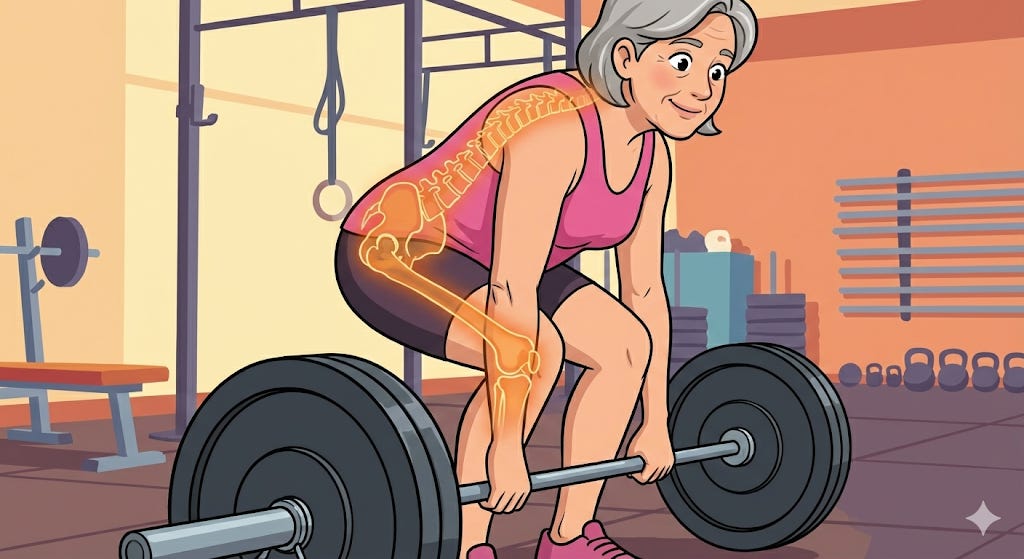
The training group performed 2 x 30-minute supervised sessions, deadlift, back squat, and overhead press at >85% of one-rep maximum (5 sets × 5 reps), plus jumping chin-ups with drop landings.
At eight months: lumbar spine BMD improved +2.9% in the training group versus −1.2% in controls. Femoral neck: +0.3% versus −1.9%. Femoral neck cortical thickness: +13.6%. These are the largest bone density gains recorded in any supervised exercise trial with postmenopausal women.
Two things that matter for interpreting these results, LIFTMOR participants were supervised by skilled trainers throughout, and roughly 18% of those initially screened were excluded due to other health issues. The protocol worked in a well-supported, relatively healthy subset of this population. That caveat matters for program design, particularly the supervision point.
On falls, which is where bone density ultimately meets real-world risk, Sherrington et al.’s 2019 Cochrane review (108 RCTs, 23,407 participants) found exercise reduces fall rates by 23% on high-certainty evidence. Programs combining resistance and balance work achieved 34%.
The Plan
Structure across all phases
Impact block
Resistance block
Balance finisher
This order is deliberate. Impact loading requires your nervous system at its freshest. The resistance block is where the primary osteogenic stimulus lives. The balance finisher addresses fall risk, which is what makes any of this matter clinically.
Frequency: 2–3 sessions per week, minimum 48 hours between sessions. Bone mechanosensitivity recovers across roughly this window, loading before it has recovered produces significantly less bone formation than waiting.
Three levels throughout: Foundation, Standard, and Progressive. If you’re new to resistance training, start at Foundation regardless of your general fitness. It’s not a lesser version of the plan — it’s the technical base that the heavier loading requires.
Phase 1: Foundation (Weeks 1–8)
Goal: Establish movement quality. Begin exposing bone to novel mechanical load at sub-maximal intensity.
Impact Block
In Phase 1, impact work is controlled. The goal is to teach landing mechanics and begin building tissue tolerance before adding complexity.
Foundation: Heel-drop march (20 steps) and 2-footed step-down
Standard: 2-Footed Jump and Box Jump
Progressive: Single-leg drop landing and Lateral Bound.
Protocol: 3 sets × 8 reps at each level.
Resistance Block
Three movements, hip hinge, squat pattern, vertical press.
Phase 1 loads are 50–65% of estimated maximum, or bodyweight/light dumbbells if you’re new to lifting.
Hip Hinge:
Foundation: Romanian deadlift with dumbbells — 3 × 10 reps
Standard: Conventional barbell deadlift — 3 × 8 reps (~55–65% 1RM)
Progressive: Trap bar deadlift — 4 × 6 reps (~65–70% 1RM)
Squat Pattern:
Foundation: Goblet squat with kettlebell — 3 × 10 reps
Standard: Barbell back squat — 3 × 8 reps (~55–65% 1RM)
Progressive: Barbell back squat — 4 × 6 reps (~65–70% 1RM)
Vertical Press:
Foundation: Seated dumbbell overhead press — 3 × 10 reps
Standard: Standing barbell overhead press — 3 × 8 reps (~55–65% 1RM)
Progressive: Standing barbell overhead press — 4 × 6 reps (~65–70% 1RM)
Rest between sets: 2–3 minutes. The rest interval is part of the stimulus.
Balance Finisher
Single-leg stance, 30 seconds each side, eyes open. Build to eyes closed over four weeks, then progress to eyes closed on a mildly unstable surface (folded mat or pillow). Five minutes, every session.
Phase 2: Loading (Weeks 9–20)
Goal: Progress toward the load range the LIFTMOR trial used, 80–85%+ of 1RM. Add plyometric complexity.
Frequency: 2–3 sessions per week.
Impact Block — Phase 2
Foundation: Box Jump
Standard: Higher Box Jump and Lateral Bound for distance
Progressive: Depth Jump, 30cm drop, maximal rebound and Lateral Bound for distance.
Protocol: 3 sets × 6–8 reps. The volume is deliberately modest. 95% of bone mechanosensitivity is dampened after just 20–40 loading cycles. More reps past that point add negligible bone stimulus and increase injury risk. Ten well-executed, properly rested jumps outperforms thirty rapid ones.
Resistance Block — Phase 2
Target by end of this phase: 5 sets × 5 reps at 75–85% 1RM on all three primary lifts. This is the LIFTMOR protocol.
Add one pulling movement in Phase 2, bent-over barbell row or seated cable row, 3 × 8–10 reps.
Upper body fragility fractures, wrist, forearm, shoulder, significantly compromise independence and are under addressed in most bone health programs. Pulling movements load the humerus, radius, and ulna from angles the press does not.
Load progression rule:
Add 2.5–5kg every 2–3 weeks when you complete all prescribed sets with consistent technique.
Keep a training log.
Progression over twelve months produces substantially better results than occasional heavy efforts with no tracking.
Phase 3: Maintenance (Week 21 onwards)
This is not a phase you graduate from. This is the work, ongoing.
Two sessions per week at the loads built in Phase 2. The LIFTMOR participants maintained this for eight months.
One thing to manage deliberately here is exercise variety.
Bone cells get used to habitual loading patterns, the same movement at the same load eventually stops being a novel stimulus and produces less adaptation.
Rotating exercise variations every 8–12 weeks addresses this.
Conventional deadlift to Romanian to trap bar.
Back squat to Bulgarian split squat.
Barbell overhead press to landmine press.
The loading parameters stay the same. The direction of force changes slightly, and bone continues to respond.
The Non-Negotiables
Load is the variable that decides outcomes.
Low-intensity exercise was largely ineffective for bone.
If you can comfortably complete 15 reps, the weight isn’t sufficient.
You need loads where 5–8 technically clean repetitions is genuinely challenging.
Impact loading cannot be replaced by resistance training alone. Ten jump reps before your resistance session, three times per week, takes under five minutes and addresses the femoral neck gap that resistance-only programs leave.
Even a few sessions with a coach at the beginning, enough to get the deadlift, squat, and press mechanics right is one of the highest-value investments in yourself.
Consistency over twelve months outperforms any eight-week effort.
Bone remodels slowly.
The adaptation timeline is measured in months and years, not weeks.
An adequate program done every week produces better long-term outcomes than an optimal program abandoned at six weeks.
What to Expect and When
Weeks 1–4: Strength increases quickly but bone density hasn’t changed. This is neurological adaptation, your nervous system learning to recruit motor units more efficiently. Real progress, just not the kind a DEXA scan shows yet.
Weeks 5–16: Muscle mass increases. The forces transmitted through bone increase proportionally. If you haven’t had a baseline DEXA scan, this is a good window to get one.
Months 4–8: Early bone density changes typically appear at the lumbar spine before the hip. LIFTMOR showed +2.9% at the spine by month eight.
Month 12 onwards: Measurable changes at both spine and hip on DEXA. A 1–3% gain sounds modest. What it represents is a 2–4% swing relative to the untrained, compounding year on year.
Why Starting After 40 Still Makes a Difference
I see this misunderstood in clinic regularly. Patients come in at 58, 63, 67, their DEXA has come back showing low bone mass, and somewhere between the GP appointment and seeing me, they’ve got the idea that it’s largely too late. This is what my Nan believed and this is what I want to change.
It isn’t.
Bone tissue does not stop responding to mechanical stimulus at any age.
The LIFTMOR participants averaged 65 and already had osteopenia.
They still gained 2.9% lumbar BMD in eight months.
The EFOPS participants were tracked for 16 years from early postmenopause, and the exercise group continued to outperform controls at every measured timepoint across that entire period.
You cannot reverse decades of accumulated loss. But the trajectory changes from the day you start loading consistently.
If you have questions about where to start within the three levels, or about adapting this around a specific injury or diagnosis, leave them in the comments. I read everything and reply to as many as I can.
References
Warming L et al. (2002). Bone mineral density changes in premenopausal women. Osteoporosis International, 13(7):581–587.
Greendale GA et al. (2012). Bone mineral density loss across the menopause transition. Journal of Bone and Mineral Research, 27(9):2057–2068. (SWAN study)
Riggs BL & Melton LJ (1986). Involutional osteoporosis. New England Journal of Medicine, 314(26):1676–1686.
Johnell O & Kanis JA (2005). Epidemiology of osteoporotic fractures. Osteoporosis International, 16(Suppl 2):S3–7.
Haentjens P et al. (2010). Meta-analysis: excess mortality after hip fracture. Annals of Internal Medicine, 152(6):380–390.
Frost HM (1987). Bone “mass” and the “mechanostat”: a proposal. The Anatomical Record, 219(1):1–9.
Colaianni G et al. (2015). The myokine irisin increases cortical bone mass. PNAS, 112(39):12157–12162.
Zhao R et al. (2015). The effects of differing resistance training modes on BMD in postmenopausal women: a meta-analysis. Osteoporosis International, 26(3):847–860.
Watson SL et al. (2018). LIFTMOR randomised controlled trial. Journal of Bone and Mineral Research, 33(2):211–220.
Kemmler W et al. (2015). Exercise and fractures in postmenopausal women: EFOPS final results. Osteoporosis International, 26(10):2491–2499.
Bassey EJ et al. (1998). Pre- and postmenopausal women have different BMD responses to high-impact exercise. Journal of Bone and Mineral Research, 13(12):1805–1813.
Srinivasan S et al. (2002). Rest intervals improve bone structure and strength after mechanical loading. Journal of Bone and Mineral Research, 17(9):1613–1620.
Sherrington C et al. (2019). Exercise for preventing falls in older people: Cochrane review. Cochrane Database of Systematic Reviews, Issue 1: CD012424.
Hoffmann I & Kemmler W et al. (2022). Exercise reduces osteoporotic fractures: does supervision make a difference? Journal of Bone and Mineral Research, 37(12):2504–2519.
Kistler-Fischbacher M et al. (2021). The effect of exercise intensity on bone in postmenopausal women (part 2): meta-analysis. Bone, 143:115549.
Turner CH (1998). Three rules for bone adaptation to mechanical stimuli. Bone, 23(5):399–407.
Hart NH et al. (2017). Mechanical basis of bone strength: influence of bone material, structure and muscle action. Journal of Bone and Mineral Research, 32(3):470–480.
Jordan, this article and your explanations were phenomenal. However as other women have commented, I have no idea what those exercises are or the proper form.
Question: Can you make a program where you film a mature woman doing the full workout in the 3 variations: Foundation, Standard and Progressive? Sell it either as a Stand Alone program or as part of your paid membership.
I would be interested in this, as I think many others would as well. I have not lifted weights in 20 years and need something visual to follow along, to compare my movements to as I work out. Please consider this.
Thank you.
Any recommendations for links/resources that demonstrate the impact block exercises in particular? (aside from a basic YouTube/Google search?)