
3 Supplements That Actually Matter for Your Bones
And Why You're Probably Taking Them Wrong

Cutting Through the Supplement Confusion
Walk into any health shop and you’ll find dozens of supplements claiming to support bone health.
When it comes to bone health supplementation, three nutrients matter most, calcium, vitamin D, and vitamin K2. Everything else is either adequately provided by a decent diet or has limited evidence for bone benefits.
But, even these three essential nutrients are misunderstood. Most people either take too much, too little, at the wrong time, or in forms their bodies struggle to use effectively. And almost everyone misses that supplements work best when combined with the right kind of exercise.
If you’re enjoying Strong To The Bone - Then please help me grow the newsletter by either subscribing or sharing with a friend. Every addition makes such a difference! I appreciate you all.
Calcium, More Isn’t Always Better
Calcium is the most abundant mineral in your bones, making up a large percentage of your body’s calcium stores. It’s the building material that makes bones hard and strong. This is why calcium has dominated the bone health conversation for decades, it seems logical that if bones are made of calcium, consuming more calcium would build stronger bones.
Except it’s not that simple.
Your body is constantly managing calcium levels. When dietary calcium is low, your body pulls it from your bones to maintain blood calcium levels (which are critical for heart function, muscle contraction, and nerve signalling). But when you consume adequate calcium, simply adding more doesn’t automatically mean stronger bones. Research consistently shows that calcium intake above 1,200-1,500mg daily provides no additional bone benefit.
In fact, high calcium supplementation, particularly when taken in large single doses, may even increase cardiovascular risk in some individuals. The calcium circulating in your bloodstream needs to end up in your bones, not deposited in your arteries.
Calcium is necessary but not sufficient for bone health. Think of it as the bricks in a building. You need bricks, absolutely. But bricks alone, without a blueprint, skilled labour, and proper construction techniques, don’t create the building. Your bones need calcium, but they also need the right signals to incorporate that calcium into bone tissue rather than leaving it floating in your bloodstream.
Most people can obtain adequate calcium from food sources, dairy products, leafy greens, tinned fish with bones, fortified plant milks, and certain nuts and seeds.
Supplementation becomes important when dietary intake consistently falls short, but the goal should be meeting your daily target, not exceeding it. And here’s the crucial bit, the form of calcium supplement matters, as does when and how you take it. But we’ll get to that.
Vitamin D: The Absorption Master Key
If calcium is the building material, vitamin D is the construction manager that ensures calcium gets where it needs to go. Without adequate vitamin D, you could consume all the calcium in the world and your body would struggle to absorb it from your digestive tract and incorporate it into your bones.
Vitamin D does far more than just support calcium absorption. It plays crucial roles in muscle function, immune system regulation, and even fall prevention. For bone health specifically, vitamin D is absolutely essential, there’s no way around it.
Vitamin D deficiency and insufficiency is common, particularly in the UK and Northern Areas of the US. Our northern latitude means that from October through March, the sun’s angle prevents any meaningful vitamin D creation in our skin, even on sunny days.
During summer months, adequate sun exposure can produce vitamin D, but this requires exposing a reasonable amount of skin (arms and legs, not just face and hands) to midday sun for 10-30 minutes several times weekly, something many people don’t achieve due to indoor lifestyles, sun protection practices, or legitimate concerns about skin damage.
Darker skin pigmentation, age, obesity, and certain medications further reduce vitamin D status. Unlike calcium, which most people consume adequate amounts of through food, vitamin D is genuinely difficult to obtain from diet alone. Fatty fish, egg yolks, and fortified foods provide some, but rarely enough to maintain optimal levels without supplementation.
The confusing part about vitamin D is determining “optimal.” Blood test results measure 25-hydroxyvitamin D, and there’s ongoing debate about ideal levels. The NHS suggests that levels above 25 nmol/L prevent deficiency, but many bone health specialists argue for higher targets, around 75-100 nmol/, for optimal bone health and fracture prevention. This gap between preventing severe deficiency and optimising bone health is where much confusion sits.
What’s clear from research is that vitamin D supplementation improves calcium absorption, reduces bone turnover (the breakdown of old bone), and when combined with adequate calcium intake, reduces fracture risk. The standard UK recommendation is 400 IU (10 micrograms) daily for adults, but many people require higher doses to actually achieve and maintain adequate blood levels, sometimes 1,000-2,000 IU (25-50 micrograms) daily or more, particularly during winter months.
Vitamin K2. The Nutrient You’ve Probably Never Heard Of
While most people have heard about calcium and vitamin D for bone health, vitamin K2 remains relatively unknown despite playing a role in bone health.
First, let’s clarify the vitamin K family. There’s vitamin K1 (phylloquinone), found abundantly in leafy green vegetables, which is important for blood clotting. Then there’s vitamin K2 (menaquinone), found in fermented foods and animal products, which has different functions in the body, particularly for bone and cardiovascular health.
Vitamin K2’s job is to activate proteins that regulate where calcium goes in your body. Specifically, it activates osteocalcin, a protein that binds calcium into your bone matrix, and not in the soft tissues. In other words, vitamin K2 helps ensure that calcium ends up in your bones where you want it, not in your blood vessels where you don’t.
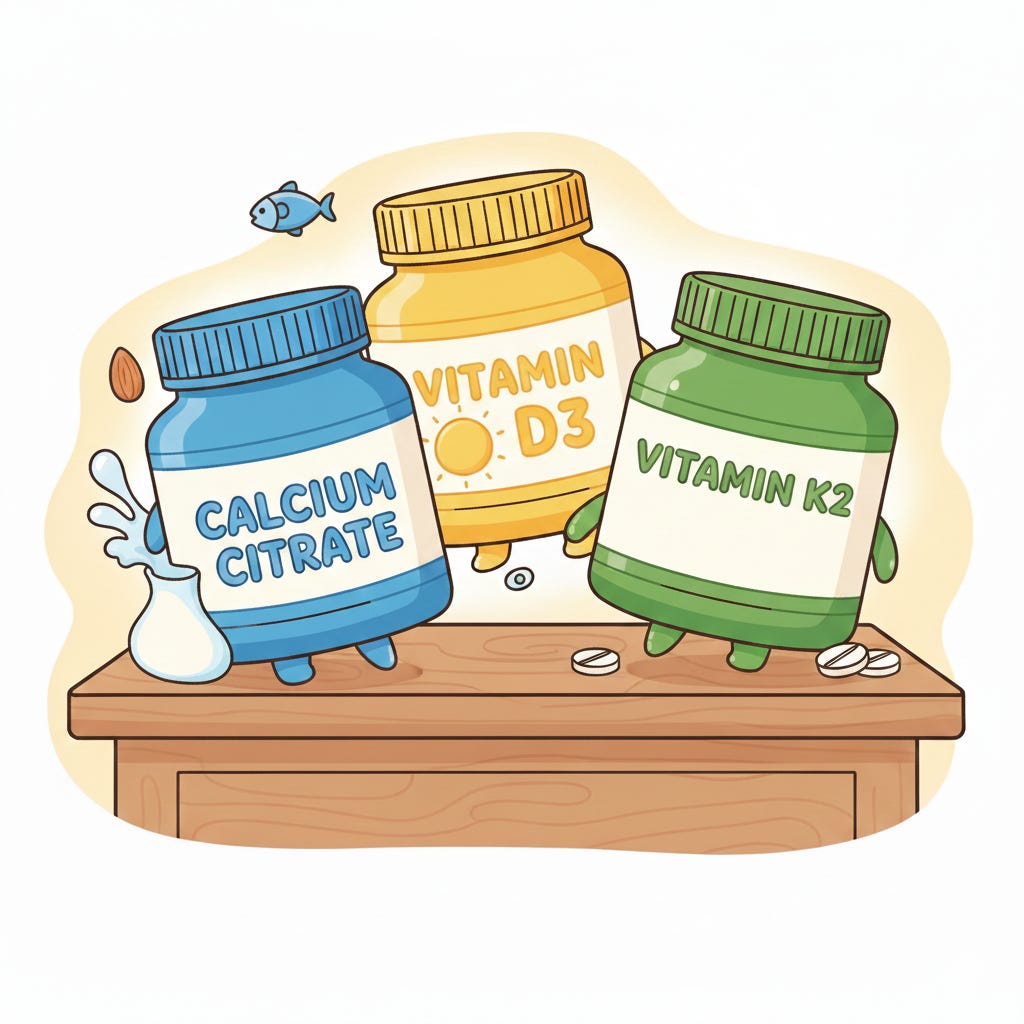
This is why the combination of calcium, vitamin D, and vitamin K2 works, vitamin D ensures you absorb calcium, vitamin K2 directs that calcium to your bones, and the calcium provides the mineral building blocks for bone tissue.
The challenge with vitamin K2 is that dietary sources are limited and often unfamiliar to Western diets, achieving optimal intake from food alone is difficult for most people.
The research on vitamin K2 supplementation for bone health is promising but still developing. Several studies have found that vitamin K2 supplementation (particularly the MK-7 form) improves bone strength markers and may reduce fracture risk, especially when combined with vitamin D. The effects appear most pronounced in postmenopausal women.
Why These Three Work Together
Understanding how calcium, vitamin D, and vitamin K2 work together transforms them from random supplements you take into a coordinated strategy.
Vitamin D ensures your digestive system can actually absorb the calcium from your food and supplements. Without adequate vitamin D, you could consume enormous amounts of calcium and most of it would pass straight through your system unused.
Calcium provides the mineral that physically makes up bone structure. It’s the raw material that needs to be incorporated into your bone matrix.
Vitamin K2 activates the proteins that take the calcium from your bloodstream and bind it into your bone tissue, while simultaneously preventing that calcium from depositing in places it shouldn’t (like your arteries).
The timing of supplementation also matters more than most people realise. Calcium absorption is limited to about 500mg at once, which is why taking a 1,000mg calcium supplement in a single dose is wasteful. Your body can’t absorb it all at once. Splitting calcium into smaller doses taken at different times of day improves absorption.
The Bigger Picture. Supplements Support, They Don’t Replace
Supplements support bone health, but they cannot replace the stimulus that actually builds bone tissue. That stimulus is mechanical loading through exercise.
Your bones respond to stress. When you place significant force on your bones through resistance training or impact activities, your bones adapt by becoming denser and stronger. This is a biological response that no amount of supplementation can replicate. Calcium, vitamin D, and K2 ensure you have the building materials and machinery to build bone, but without the right exercise stimulus, your bones have no reason to actually use those materials.
Research comparing calcium supplementation alone versus exercise alone consistently shows that exercise provides greater fracture risk reduction. The most powerful approach combines both, providing adequate nutrition and supplementation while also engaging in regular bone-loading exercise.
Giving your body calcium supplements without doing bone-loading exercise is like delivering bricks to a construction site where no one is building anything. Exercise is the signal that tells your body “we need stronger bones here” and only then does your body use those calcium, vitamin D, and K2 resources to actually build denser bone tissue.
Moving Forward: What You Actually Need to Know
Let’s bring this together into practical guidance:
Calcium: Most women need 1,000-1,200mg daily from all sources (food plus supplements). Try to get as much as possible from food, and if supplementing, split doses rather than taking it all at once.
Vitamin D: This is where supplementation is most likely necessary, particularly in the UK. Most women benefit from 1,000-2,000 IU (25-50 micrograms) daily, sometimes more.
Vitamin K2: The research is promising, particularly for the MK-7 form at doses around 100-200 micrograms daily. This is difficult to achieve through food alone.
Exercise: Non-negotiable. Your supplement strategy means very little without consistent resistance training and bone-loading activity.
If you have any or many health conditions and you’re unsure how to adjust for medications or health conditions it’s always worth discussing with your Doctor.
What matters most is understanding that bone health isn’t about one magic supplement. It’s about providing your body with the nutritional building blocks it needs (calcium, vitamin D, K2, along with adequate protein and other nutrients from a good diet) while giving your bones the mechanical stimulus they need through exercise. Get both aspects right, and your bones will respond.
Your bones are living tissue that continuously remodels itself. Give them the right signals and the right support, and they’ll serve you well for decades to come
.
Very helpful! I take D3 and K 2 every day and have those checked annually. I don’t take calcium but try to get it in food. Your reminder that strength training is necessary lit a fire under me 😉
Excellent, clear summary. While you can get your calcium needs met via diet alone as a dietitian I find many of my clients have to be very mindful of their choices to reach the target. It can be especially challenging if they don’t include dairy(or plant fortified) products.